
This article will take you through the complete structure of science, from its four major branches to its overlapping fields, simply and engagingly.
You may have probably heard many subject names ending with “science”. For example, physical science, computer science, or environmental science.
It is easy to think of “science” as one big, uncategorized subject. In reality, scientists group science into clear branches and disciplines so that people can specialize and work together more effectively. According to the standard structure, the natural sciences, formal sciences, social sciences, and applied Sciences are known as the primary branches of science.
You can explore these four main branches of science with following sub topics
- The main branches of science
- What the natural sciences are and how they are divided into physical, life, and Earth sciences
- What the formal sciences are and why they are tools for other sciences
- What the social sciences are and which subjects belong there
- What the applied sciences are and how they turn theory into technology and solutions
- Examples of overlapping and interdisciplinary fields (such as biochemistry, geophysics, bioinformatics, and environmental science)
- A summary table of the branches of science and key examples
After reading this article, you will see that no one can become an expert in every scientific field, and that is completely normal. Each branch of science is like a different world, and each researcher focuses on a small part of that world.
At the same time, the branches are strongly connected: basic knowledge from one area (for example, mathematics or physics) is often needed to make progress in others (like engineering, economics, or environmental science).
Your goal is not to master everything, but to find the “diamond area” that fits your interests and talents. Understanding the branches of science helps you see where your favorite subjects belong and how they link to other fields.
The main branches of science
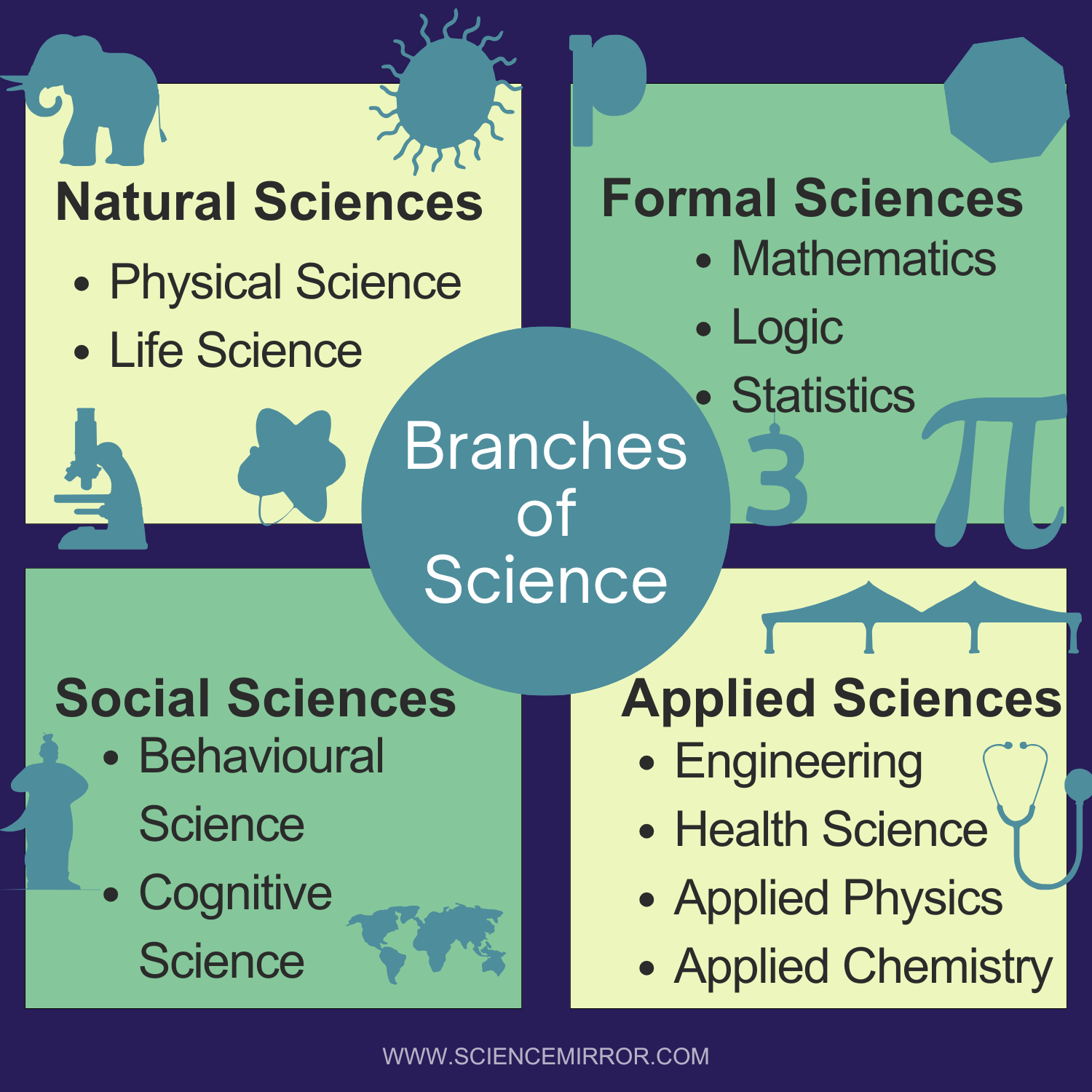
Science is commonly divided into four main branches
- Natural sciences – Study the natural world, including matter, energy, living things, Earth, and the universe.
- Social sciences – Study people, behavior, societies, and cultures.
- Formal sciences – Study abstract systems such as numbers, logic, and information.
- Applied sciences – Use knowledge from the other branches to solve practical problems in medicine, engineering, agriculture, technology, and more.
Each branch contains many sub‑branches (disciplines) and smaller specialties, and many modern fields sit at the overlap between two or more branches.
The Formal Sciences serve as a tool for both the Natural and Social Sciences to advance applied science. As I mentioned above, all of these areas are interconnected.
If you are a student, you may study biology, chemistry, and Physics under the name of science subjects. So, sometimes you may say these three subjects are the main branches of science. But these three study areas are only sub-branches of the natural sciences.
All of the general people indeed see science through only these three main windows. Outside the classroom, science includes many more areas, such as psychology, economics, geology, computer science, and health sciences.
Let’s deeply explore those areas.
What are the natural sciences?
Do you want to learn about the nature? Then, this is your major study area.
Natural sciences explain the various rules of the nature by using the scientific method.
Scientists observe their environment and identify a specific problem or get a problem from the day-to-day that is bound with nature. Then they apply the scientific method to find the solution or explain the problem. The scientific method is the main procedure for conducting standard research.
As I mentioned earlier the natural sciences are divided into two main branches,
What are the physical Sciences?
Physical Science is an important branch of science. If we consider all branches of science, the physical sciences can be introduced as the platinum subject area. Because the knowledge of this subject area is very important for all other subject areas also. Even social sciences.
Subject areas of physical sciences,
This valuable science subject area has four sub subject areas they are,
- Physics
- Chemistry
- Space Science
- Earth Science
All science lovers know the value of these subjects. Actually, the modern technical world totally depends on the explanation of physics.
Theories of physics helped in invent of the transistors. What the electricians do is combine these transistors with logic and make a useful application for humans. Like this, we can explain the importance of these subjects.
Let’s see the each of these subjects.
The Science of matter, Chemistry.
Chemistry studies matter (anything that has mass and occupies space), how it is built (atoms, molecules), and how it changes in different conditions. Traditionally, chemistry is divided into several main branches:
- Organic chemistry
- Inorganic chemistry
- Physical chemistry
- Analytical chemistry
Organic chemistry chemists study carbon-based matters and make affordable applications to the world. All other matters on the earth are studied through inorganic chemistry.
There are many overlapping sub‑branches, such as organometallic chemistry, which studies compounds that contain both metals and organic groups.
The science of systems, Physics
Physics is the science that describes how systems behave in space and time: their motion, energy, forces, and interactions. Physics is an observable subject, everything from galaxies and stars to electrons and atoms, and even to aspects of living systems.
Broadly, physics includes:
- Classical (Newtonian) physics – Motion, forces, gravity, and everyday scales.
- Modern physics – Quantum mechanics and relativity, which describe very small and very fast systems.
The science of space, Space Science.
It doesn’t matter if you don’t love science words. Even a child likes to know about space. Specially planets, stars, black holes, etc., the study of these things is known as astronomy. Under astronomy, in brief, we can say its study of the visible space.
The study area about the whole universe known as cosmology. Another interesting and endless subject area.
The science of our living planet, Earth Science.
These fields are part of a broader interdisciplinary approach often referred to as Earth System Science, which looks at how the atmosphere, hydrosphere, lithosphere, and biosphere interact.
It includes fields like:
- Geology (solid Earth)
- Meteorology (weather and atmosphere)
- Oceanography (oceans)
- Hydrology (water systems)
What is life science?
There is no single perfect definition of “life”. Instead, biology describes characteristics of living things, such as growth, reproduction, metabolism, and response to stimuli. Life sciences (or biological sciences) study these living systems at many levels.
- Major life science branches include:
- Biology – General study of living organisms.
- Zoology – Study of animals.
- Botany – Study of plants.
- Microbiology – Study of microscopic organisms.
- Genetics and molecular biology – Study of genes, DNA, and molecular processes.
- Ecology – Study of ecosystems and interactions among organisms and their environment.
Modern biology also includes systems biology, bioinformatics, and synthetic biology, which combine biology with mathematics, computer science, and engineering
What are the formal sciences?
The difference between natural science and formal science is that, in formal science, not all theories can be proven in the real world like natural sciences. All theories in formal science come with human imagination. Let’s see the major areas of formal science.
- Main areas of formal science include:
- Mathematics – Study of numbers, quantities, shapes, and structures.
- Logic – Study of valid reasoning and arguments.
- Statistics – Methods for collecting, analyzing, and interpreting data.
- Theoretical computer and information science – Abstract models of computation and information.
Mathematics often use as a tool for understand the natural subjects.
Statistics is needed to design experiments, analyze data, and test hypotheses in every empirical science.
What are the social sciences?
Do you want to study law, History, the relationship among humans, languages like subjects?
Then you have to collect knowledge under the social sciences. Social sciences focus on humans, groups, and societies, and how people behave, interact, and organize.
- Major social science disciplines include:
- Psychology – Study of behavior and mental processes.
- Sociology – Study of social groups, institutions, and social change.
- Economics – Study of production, distribution, and use of resources.
- Political science – Study of politics, power, and government.
- Anthropology – Study of cultures, human evolution, and societies.
- Human geography – Study of how humans use and organize space.
- Law, education, and communication studies are often linked to the social sciences.
What are the applied sciences?
All the other three science branches study the theory of the particular subjects. By knowing only about the theories of a specific subject, it’s hard to have the benefits of that subject. Therefore, the applied science area came into the science subjects.
In applied science it is study about how to theories of a subject apply for the humans’ applications. Such as making inexpensive fuels for energy requirements.
This branch is a significant branch of science. Because we want an application from science rather than knowing the theories. All of the industrial applications come with applied sciences studies. For example most popular artificial intelligence study area comes under computer science which is belongs to applied science. Also, all of the science subjects have an applied science area, for example, applied physics, applied mathematics, Applied Biology, etc.
Applied sciences include,
- Engineering and technology – Use physics, mathematics, and materials science to design and build structures, machines, electronics, and software.
- Computer science and information technology – Design algorithms, software, and digital systems (with both theoretical and applied sides).
- Health and medical sciences – Apply biology, chemistry, and social science to diagnose and treat diseases (medicine, nursing, pharmacy, public health).
- Agriculture – Apply biology, chemistry, physics, and social science to food production.
Overlapping science subject areas
When we consider all of the different science subject areas. It can introduce a new study area by combining two of these science subjects. Look about the following examples.
Biochemistry
The combination of Biology and Chemistry make a new study area known as the Biochemistry.
Geophysics
The Combination of the Gelogogy and Physices sub subjects areas makes the geophysics subject
Biostatistics.
Biology from natural sciences and statistics as a tool from formal sciences can be combined and then known as biostatistics.
Astrobiology
Study the life of outer the earth known as astrobiology. Astronomy comes from space sciences, and biology comes from the natural sciences.
Environmental Science
This is an interdisciplinary field. To excel in environmental science, you need to gain knowledge in Chemistry, Biology, Physics, and even Geology. Sometimes you will need social science knowledge to answer the questions in environmental science. This understanding is essential to achieving sustainable goals through green living practices.
Like this Human can make a lot of studying areas by combining science subjects.
In addition to above list, Modern lists of branches of science also include many other interdisciplinary fields, such as bioinformatics, neuroengineering, climate science, data science, and planetary health, which grow at the intersections of older disciplines.
Branches of science complete summary
The Board area of science can be categorized according to the following table with four main branches.
| Main Branch | Sub‑branch / Group | Examples of disciplines |
|---|---|---|
| Natural Science | Physical Science | Physics, Chemistry, Astronomy, Earth Science (Geology, Meteorology, Oceanography) |
| Life Science | Biology, Zoology, Botany, Microbiology, Molecular Biology, Genetics, Ecology | |
| Formal Science | – | Mathematics, Logic, Statistics, Theoretical Computer Science, Decision Theory |
| Social Science | – | Psychology, Sociology, Economics, Political Science, Anthropology, Human Geography, Education, Law. |
| Applied Science | Engineering & Technology | Civil, Electrical, Mechanical, Chemical, Software, Industrial Engineering, Operations Research, Computer Science (applied side) |
| Health & Medical Sciences | Medicine, Nursing, Pharmacy, Dentistry, Public Health, Health Science | |
| Agricultural & Environmental | Agriculture, Environmental sustainability, Forestry, Environmental Engineering |
Science is not just a subject you study in school. It is a powerful system for understanding the world.
By dividing science into branches, we make it easier to explore. But by connecting those branches, we unlock its true potential.
So instead of seeing science as separate subjects, start seeing it as a connected web of knowledge. That’s where real understanding begins.
Thanks a lot for providing information on science topic